|

Act I: The Alternative Plans
|
- Scene 1: Laying Down the Rules
- May 14: Constitutional Convention lacks necessary quorum
- May 25: Constitutional Convention meets quorum requirement
- May 28: Committee on Rules Reports rules for Convention
|
|
|
|
|
- Scene 4: Madison-Sherman Exchange
- June 6: Are people "more happy in small than large States?" Should Resolution 4a be adopted?
-
| Resolution 4a: |
Defeated motion to have State Legislature elect First House of National Legislature (8 - 3).
Sherman: "The people are more happy in small than large states." His argument invokes the traditional understanding of republicanism.
Madison: We need to "enlarge the sphere." His argument points back to "vices" and forward to Federalist 10.
|

Madison's Notes of the Debates
|
- Scene 5: Second Discussion of the Virginia Plan
- June 7: How to fill "the chasm" created by defeat of Resolution 5a
- June 8: Resolution 6 and the negative on State laws
- June 9: Reconsideration of Resolution 7
|
- Scene 6: The 19 Resolutions of the Amended Virginia Plan
- June 11: Popular representation in both branches?
- June 12: The Specifics of Representation
-
| Resolution 15: |
Agreed (5 - 3 - 2) to refer Constitution to the people of the several states for ratification. Pennsylvania not voting. |
 |
| Resolution 4b: |
Agreed (7 - 4) on three-year terms for First House of National Legislature. |
 |
| Resolution 4c: |
Struck out, without discussion, rotation and recall provisions, the end of a republican tradition. |
 |
| Resolution 4d: |
Agreed (8 - 3) to provide "Liberal compensation for members of the First House to be paid from the National Treasury." |
 |
| Resolution 4e : |
Agreed (8 - 1 - 2) to make members of First House ineligible for offices under the National Government for one year after leaving the House. |
 |
| Resolution 5b,c: |
Agreed to require a minimum age of 30 (7 - 4) and a seven-year term for Senators (8 - 1 - 2). |
 |
| Resolution 5d: |
Defeated (7 - 3 - 1) no pay for Senators. |
 |
| Resolution 9: |
Discussed and postponed the jurisdiction to be given the Supreme Court. |

Madison's Notes of the Debates
- June 13: Amended Virginia Plan
|
|
|
|
|
|
|
|

Act II: The Connecticut Compromise
|
- Scene 1: Consideration of Revised Virginia Plan
- June 20: Lansing questions legality of the Amended Plan
-
| Revised Resolution 1 and 2: |
Debated the issue of a two-house legislature. |
 |
| Revised Resolution 2: |
Defeated (6 - 4 - 1) a motion to consider vesting the powers of legislation in a one-house Congress. |

Madison's Notes of the Debates
- June 21: Specifics of House Representation discussed
- June 22: Specifics of House Representation discussed
-
| Revised Resolution 3c: |
Defeated a motion to permit First House to determine its pay. (7 - 2 - 2) |
 |
| Revised Resolution 3d: |
Defeated a move to strike the National Treasury as the source of pay (5 - 4 - 2). |
 |
| Revised Resolution 3: |
Agreed on minimum age of 25 for members of House (7 - 3 - 1). |
 |
| Revised Resolution 3: |
Discussed making members ineligible for other state or national office during their own term of office plus one year after leaving office. Defeated motion to strike (4 - 4 - 3). |

Madison's Notes of the Debates
- June 23: Ineligibility requirements for members of Congress
-
| Revised Resolution 3: |
Defeated (5 - 5 - 1) a motion by Butler to provide House members adequate compensation from the National Treasury.
|
 |
| Revised Resolution 3: |
Agreed (8 - 3) to strike ineligibility of House members for other Federal Offices. |

Madison's Notes of the Debates
- June 25: The purpose of the Senate
-
| Revised Resolution 4: |
Agreed (5 - 5 - 1) to change "Second Branch of the National Legislature" to "Second Branch of the United States Legislature."
|
 |
| Revised Resolution 5: |
Agreed (9 - 2) to election of the Second Branch by State Legislatures. |
 |
| Revised Resolution 4b: |
Agreed unanimously to minimum age of 30 for Senators. |

Madison's Notes of the Debates
- June 26: Specifics of Senate Representation discussed
- June 27: Resolutions 7 and 8 discussed
-
| Revised Resolution 6: |
Postponed. |
 |
| Revised Resolution 7: |
Discussed "the right of suffrage in the first branch." |
 |
| Revised Resolution 8: |
Discussed "the right of suffrage in the second branch" to be the same as the first branch. |
 |
| Luther Martin delivers a three-hour "desultory" speech, the substance of which was "that an equal vote in each State was essential to the federal idea, and was founded in justice & freedom, not merely in policy." |

Madison's Notes of the Debates
- June 28: Luther Martin resumes his "discourse" on the role of the States
|
- Scene 2: Contours of Compromise: Partly Federal, Partly National
- June 29: Ellsworth: "we were partly national; partly federal"
-
| Revised Resolution 7: |
Approved (6 - 4 - 1) proportional representation in the House. |
 |
| Revised Resolution 7: |
Approved (9 - 2) a motion to postpone consideration of rest of Resolution 7, representation by States in Second Branch. |

Madison's Notes of the Debates
- June 30: Loose talk of division and disunion
-
| Defeated (5 - 2 - 1) resolution to ask New Hampshire to send its delegates. |
 |
| Revised Resolution 8: |
Ellsworth introduces "Connecticut Compromise Motion": Equal representation in Second Branch with proportional representation in First House.
Madison claims the great divide in American politics is "having or not having slaves" rather than large and small States.
Dayton suggested, "we were partly federal, partly national in our Union."
|

Madison's Notes of the Debates
- July 2: Creation of the Gerry Committee
-
| Revised Resolution 8: |
Tied (5 - 5 - 1) on Ellsworth's motion giving each state one vote in Senate and proportional representation in House. |
 |
| Revised Resolution 8: |
Voted to commit the question (9 - 2). |
 |
| Revised Resolution 8: |
Voted to commit to committee of one member from each state (10 - 1).
Gerry chaired committee made up of Gerry, Ellsworth, Yates, Patterson, Franklin, Bedford, L. Martin, Mason, Davie, Rutledge, and Baldwin.
|
 |
| "That time may be given to the committee, and to such as chuse to attend to the celebrations of the Anniversary of Independence," the Convention adjourned till Thursday. |

Madison's Notes of the Debates
- July 3
- Gerry Committee met to work on the questions of the previous day.
|
- Scene 3: Independence Day Contemplation
- July 4: "When in the Course of Human Events"
|
- Scene 4: The Gerry Committee Compromise Proposal Discussed
- July 5: The Compromise Proposal has three components
- July 6: Debating the merits of proportional representation
- July 7: Sherman reinforces case for equal representation of States in Senate
- Gerry Committee Report:
Took up question of equal vote for each state in Second House and agreed (6 - 3 - 2) to retain this provision.
Gerry: "the new Government would be partly national, partly federal."
Madison's Notes of the Debates
- July 9: Distributing 56 seats in the House to the 13 States
- Gerry Committee Report:
Morris Committee suggested approval of the population formula (1:40,000).
Second paragraph of Gerry Committee Report was approved (9 - 2).
The first paragraph was refereed to an eleven-man committee (9 - 2).
Madison's Notes of the Debates
- July 10: North - South, Large - Small discussion
- July 11: The census and representation
- Inconclusive discussion on periodical censuses.
Defeated (7 - 3) motion to strike out 3/5 for "all." G. Morris "could never agree to give such encouragement to the slave trade."
Defeated (6 - 4) a motion "to include 3/5 of the blacks."

Madison's Notes of the Debates
- July 12: "Blacks equal to the whites in the ratio of representation?"
- Approved (5 - 4 - 1) a motion to have a census within 6 years of the First Congress.
Defeated (7 - 3) a motion for succeeding censuses every 20 years.
Agreed (8 - 2) on census every 10 years.
Defeated (8 - 2) motion "for rating blacks as equal to whites of as 3/5."
Approved (6 - 2 - 2) a motion to proportion direct taxes, including 3/5, to representation.

Madison's Notes of the Debates
- July 13: Representation in the Senate
- Approved (5 - 4 - 1) a motion to proportion direct taxes to the number of representatives until the first census.
Agreed (9 - 0 - 1) that the Legislature can regulate the number of representatives in accordance with the number of inhabitants.
G. Morris and Butler have a pointed exchange over slavery.
Confederation Congress passes Northwest Ordinance

Madison's Notes of the Debates
- July 14: Does partly national, partly federal make sense?
- Defeated (5 - 4 - 1) a motion to limit representation of new western states.
Discussed equal vote for each State in Second House with money bills originating in First House.
Madison argues against the "partly federal, partly national" accomodation.
Pinckney moved "that instead of equality of votes" there should be proportional representation in the Senate. Defeated (4 - 6).

Madison's Notes of the Debates
|
|
|
- Scene 6: Return to the Amended Virginia Plan; Committee of Detail Created
- July 17: The Supreme Law of the Land and the Independence of the Presidency
-
| The delegates from large States caucused to decide whether to challenge equal representation in the Senate. They decided not to challenge the compromise. |
 |
| Revised Resolution 6b: |
Resumed consideration of the powers to be given Congress. Agreed (6 - 4) to motion to include power to legislate in all cases for the general interests of the Union and in those cases where States are separately incompetent. |
 |
| Revised Resolution 6c: |
Defeated (7 - 3) negative of State Laws. Madison thought the negative "essential," L. Martin considered it "improper." |
 |
| Revised Resolution 6c: |
Motion by L. Martin to make laws and treaties supreme law of the respective States approved nem con. |
 |
| Revised Resolution 6c: |
Began consideration of Executive.
Agreed (10 - 0) on single executive.
Defeated (9 - 1) election by citizens of the United States.
Defeated (8 - 2) election by electors appointed by State Legislature.
Approved (10 - 0) election by Legislature.
Postponed decision on 7-year term.
Defeated ineligibility requirement (6 - 4).
Defeated motion to substitute hold office "during good behavior" rather than 7 years (6- 4).
Defeated motion to strike seven years (6 - 4).
|

Madison's Notes of the Debates
- July 18: Discussion of Resolutions 11 - 16
-
| Revised Resolution 9: |
Agreed to reconsider ineligibility of Executive (8 - 0) (New Jersey and Georgia not voting).
Agreed to Executive Veto with 2/3 override.
|
 |
|
Revised Resolution 11: |
Began consideration of Judiciary.
Defeated (6 - 2) motion for appointment by Executive.
Motion for Executive nomination and appointment on advice and consent of Second House defeated (4 - 4).
|
 |
Revised Resolution 12-16: |
Agreed to let Legislature create inferior tribunals, nem con.
Agreed "that the jurisdiction shall extend to all cases arising under the national laws and to such other questions as may involve the national peace and harmony," nem con.
Agreed to admit new States with the consent of less than the whole of the National Legislature.
Began consideration of continuing the Confederation during the transitional period
Took up Guarantee of Republican Government for States.
|

Madison's Notes of the Debates
- July 19: Reconsideration of the Independent Presidency
-
| Revised Resolution 9: |
G. Morris moved to reconsider the appointment, duration, and eligibility of the Executive. Agreed (10 - 0).
Agreed (6 - 3 - 1) to Ellsworth's motions to appointment of Executive by electors chosen by State Legislatures (8 - 2).
Defeated (8 - 2) ineligibility for re-election.
Defeated (5 - 3 - 2) 7-year term.
Agreed (9 - 1) to 6-year term.
|

Madison's Notes of the Debates
- July 20: More disputation over the Independent Presidency
-
| Revised Resolution 9: |
Took up apportionment of electors among the States with a minimum of one and a maximum of three per State.
Defeated (7 - 3) motion to add an elector for New Hampshire and Georgia.
Agreed (6 - 4) to Gerry's allocation of one to three per each State.
|
 |
| Revised Resolution 9: |
Made Executive removable by impeachment (8 - 2).
Franklin saw impeachment as the republican peaceful alternative to assassination under despotism.
|
 |
| Revised Resolution 9: |
Agreed on fixed compensation, nem con.
Agreed (9 - 1) to be paid out of National Treasury.
|

Madison's Notes of the Debates
- July 21: The Council of Revision revisited
-
Revised Resolutions 10, 11: |
Wilson and Madison argued unsuccessfully on behalf of reinstating original Council of Revision.

Rejected (4 - 3 - 2) motion to join Judiciary with Executive in the exercise of veto power (New Jersey not voting, Pennsylvania and Georgia divided).
Agreed (9 - 0) on qualified Executive Veto.
Resumed consideration of Judicial appointments.
Defeated (6 - 3) Executive appointment unless Senate disagrees.
Approved (6 - 3) selection by Senate alone.
|

Madison's Notes of the Debates
- July 23: Resolutions 17 - 19 debated
-
| New Hampshire Delegates, John Langdon and Nicholas Gilman arrived. |
 |
| Revised Resolution 17, 18, 19: |
Agreed unanimously on requiring oaths by both National and State officials to support the Articles of Union.
Began discussion of ratification.
Discussion of Resolution 19 of the Amended Virginia Plan of June 13: "The amendments which shall be offered to the Confederation by the Convention, ought at a proper time or times, after the approbation of Congress to be submitted to an assembly or assemblies of representatives, recommended by the several Legislatures, to be expressly chosen by the People to consider and decide thereon."
Defeated (7 - 3) motion by Ellsworth and Paterson to amend Resolution 19 to have the new Constitution referred to State Legislatures for ratification.
Agreed (9 - 1) to referral to conventions of the people.
|
| Revised Resolution 9: |
Agreed (7 - 3) to reconsider election of the Executive.
Agreed to refer Revised Resolutions to a Committee of five members to be named the following day.
Gen. Pinckney reminded the Convention that if the Committee should fail to insert some security to the Southern States against an emancipation of slaves, and taxes on exports, he should be bound by duty to his State to vote against their Report. It was agreed nem con that the committee consist of 5 members, to be appointed tomorrow.
|

Madison's Notes of the Debates
- July 24: Controversy over the Presidency
- July 25: More discussion on the Presidency
-
| Defeated (6 - 5) resolution to let members have copies of the Revised Resolutions of the Virginia Plan during the break. |
 |
| Revised Resolution 9: |
Resumed discussion on election of the Executive.

Madison compares and contrasts the four proposals for electing the Executive. |

Madison's Notes of the Debates
- July 26: Constitutional Convention adjourns with the creation of a 5-member Committee of Detail
|
|

Intermission: Committee of Detail at Work
| July 27 - August
6: |
The Convention was in adjournment while the Committee of Detail was at work. By August 4th, the Committee draft was at the printers. |
|
|

Act III: The Committee of Detail Report
|
- Scene 1: The Structure and Powers of Congress
- August 6: Twenty-Three Articles presented
- August 7: Articles I-IV and the suffrage issue
- August 8: Article IV deliberated
- Agreed unanimously to Article IV, Section 1 concerning qualifications of the electors: "the qualifications of the electors shall be the same
as those of the electors in the several States of the most numerous branch of their own legislature."
Proceeded to Article IV, Section 2 (qualifications of House members).
Agreed (10 - 1) to seven instead of three years citizenship.
Agreed to substitute "inhabitant" instead of "resident"; defeated motions to require 3 years (9 - 2) and 1 year (6 - 4 - 1) of residence, and approved the section (11 - 0).
Agreed to Article IV, Section 3: 65 members in House from First Congress until the first census.
Took up Article IV, Section 4 (future apportionment of House).
Agreed (9 - 2) to insert "not exceeding" before 40,000.
Considered last clause of Section 4: "The Legislature shall
regulate the number of representatives by the number of inhabitants
at the rate of one for every forty thousand."
Defeated (10 - 1) a motion by G. Morris to insert "free" before inhabitants. G. Morris: "Slavery
was a nefarious institution."
Agreed to add a provision introduced by Dickinson for at least one representative for each state in the House.
Moved on to Article IV, Section 5 (money bills)
Approved motion to strike (7 - 4), thus challenging the Connecticut Compromise. Pinckney, G. Morris and Madison carry the day on this motion. Mason: "to strike out the section, was to unhinge the compromise of which it made a part."

Madison's Notes of the Debates
- August 9: Article V dissected
- Took up Article IV, Section 6 (sole power of impeachment, choose its own speaker) and 7 (filling vacancies) and approved both.
Considered Article V, Section 1 (selection of Senators and provision for vacancies).
Defeated motion to strike executive appointment to supply vacancies (8 - 1 - 1).
Agreed to give each Senator one vote and each State two members.
Article V, Section 2 agreed, nem con.
Article V, Section 3 (qualifications): 30 years old, citizen for 4 years, resident.
Defeated motion to require 14 years of citizenship (7 - 4), and 13 years of citizenship (7 - 4).
Defeated 10 years, (7 - 4), agreed to 9 years (6 - 4 - 1).
Substituted "inhabitant" for "resident".
Article V, Section 4 (Senate shall choose own officers) approved.
Took up Article VI, Section 1 (times and places of election) amended and approved.

Again, Randolph objects to defeat of Article IV, Section 5 (Money Bills).
Madison's Notes of the Debates
- August 10: Article VI and Pinckney's property qualifications
- Reheard Article IV, Section 2 (giving Legislature authority to establish property qualification for members)

Motion by Pinckney to spell out property qualifications in the Constitution rejected on voice vote. Pinckney suggested $100,000 for President and $25,000 for representatives.
Reconsidered (6 - 5) House residence requirement in Article IV, Section 2, and substituted three years for seven at request of Wilson.
Took up Article VI, Section 3 (Quorum requirements).
Added power to compel attendance of absent members (10 - 0 - 1).
Agreed to Article VI, Section 4 (each House to judge qualifications and elections of its members).
Article VI, Section 5 (freedom of debate), passed nem con.
Took up Article VI, Section 6 (rules, punishment for disorderly behavior, expulsion of members).
Agreed (10 - 0 - 1) to require 2/3 vote for expulsion.
Took up Article VI, Section 7 (Requiring journal and a record of each vote at request of 1/5 of members present), passed (7 - 3 - 1).
Madison's Notes of the Debates
- August 11: Article VI continued
- Continued on Article VI, Section 7.
Agreed (6 - 4 - 1) to non-publication in the journal of "such parts as may in their judgment require secrecy."
Took up Article VI, Section 8 (no more than 3-day adjournment without consent of other House nor to a location other than where they are sitting).
Amended (10 - 1) to preclude adjournment to another place during a session.
Reconsidered Article V, Section 5 (money bills to originate in House, and not be subject to Senate amendment).
Agreed (8 - 2 - 1) to reconsider the money bills provision of the Connecticut Compromise on Monday.

Madison's Notes of the Debates
- August 13: Reconsideration day and Dickinson's remark: "Experience must be our only guide. Reason may mislead us."
- August 14: Article VI and ineligibility
- Took up Article VI, Section 9 (ineligibility of members of legislature to other
Federal Offices).
After extensive debate, postponed until powers of Senate were determined.
Proceeded to Article VI, Section 10 (legislative pay to be fixed and paid by their state).
Agreed (9 - 2) that pay should be out of the National Treasury.
Agreed that pay be ascertained by law.

Madison's Notes of the Debates
- August 15: Reintroduction of Council of Revision
- August 16: Deliberation of the Enumeration of Congressional powers
- August 17: Deliberation of the Enumeration of Congressional powers
- Resumed discussion of Article VII, Section 1 (enumeration of Congressional powers).
Agreed (7 - 3) to elect Treasurer by joint ballot (New Jersey not voting).
Agreed to "establish inferior courts, and make rules on captures."
Agreed (7 - 3) to "define and punish piracies and felonies committed on the high seas."
Agreed similarly to "counterfeiting the securities and current coin of the United States, and offenses against the law of nations."
Changed (8 - 1) the clause Congress shall "make" war to Congress shall "declare war."
New Jersey lacked a quorum today.
"Separate questions having been taken on the 9, 10, 11, 12, and 14 clauses of the 1st Section, 7 article as amended. They passed in the affirmative."
Madison's Notes of the Debates
- August 18: Creation of the Committee of 11
- Referred a list of suggested additional Congressional powers to the Committee of Detail.
Agreed (6 - 4 - 1) to a Committee of 1 per state, chaired by William Livingston, to consider assumption of state debts.
Agreed (9 - 2) to meet daily, except Sunday, from 10:00 till 4:00, with no earlier adjournment allowed.
Continued discussion of Article VII, Section 1 (enumeration of Congressional powers).
Agreed to add "and support" to power to raise armies and agreed to strike "build and equip" in favor of "provide and maintain" navy.
Agreed to add power to make rules for government and regulation of land and naval forces.
Considered different motions giving authority over militia and referred them (8 - 2 - 1) to a committee.
Madison's Notes of the Debates
- August 20: Article VII and the Issue of a Bill of Rights
|
- Scene 2: The Slavery Question and Creation of the Judiciary
- August 21: Report of Committee of 11
- Heard a report from the Committee of State Debt Assumption and Militia Regulation, and laid it on the table.
Included assuming debts incurred "for the common defense and general welfare."
Resumed discussion of Article VII, Section 3, and agreed to it (10 - 1).
Continued discussion of Article VI, Section 12 (origination of bills).
Defeated (8 - 2 - 1) motion to apportion direct taxes to the number of representatives pending the first census.
Took up Article VII, Section 4 (no export taxes by States).
Defeated (7 - 3) move to allow export taxes for revenue only.
Defeated (6 - 5) motion to permit export taxes with 2/3 majority vote.
Approved Section (7 - 4).
Took up Article VII, Section 4 (no interference with the slave trade). "The proportions of direct taxation shall be regulated by the whole number of white and other free citizens and inhabitants, of every age, sex and condition
including threefifths of all other persons."
L. Martin, supported by Mason, suggests that the slave trade be prohibited or at least taxed. He argued that the importation of slaves "was inconsistent with the principles of the revolution."
Rutledge rejoined, "Interest alone is the sovereign principle with Nations."
Ellsworth: "The morality or wisdom of slavery are considerations belonging to the States themselves."
Adjourned.
Madison's Notes of the Debates
- August 22: Article VII, Section 4: Slavery
- August 23: Discussion of Articles VII - IX
- Took up Article VII, Section I (powers of Congress).
After considerable discussion and minor alterations agreed to section.
Passed Article VII, Section 7no titles of nobilitynem con.
Took up Article VIII
Approved adding a prohibition against Federal officers accepting foreign titles or gifts without consent of Congress.
Also accepted a restatement of Supremacy Clause.
Took up Article IX, (Senate treaty power and appointment of Judges and ambassadors) and postponed.
Took up Article VII, Section 1 (calling up militia to execute laws), amended and approved it.
Madison again, supported by Wilson and C. Pinckney, proposed a motion to restore Congressional veto power over State laws, defeated (6 - 5).
Agreed to revised Article VII, Section 1 (debts).
"The Legislature shall fulfill the engagements and discharge the debts of the United States, and shall have the power to law and collect taxes, duties, imposts, and excises."
Resumed discussion of Senate power to make treaties, appoint Ambassadors and Judges, and referred proposal to the Committee of Five.
Madison's Notes of the Debates
- August 24: Committee of 11 reports on slavery
- August 25: The Slavery Question (see also July 23, August 8, 21, 22, 26 and 29)
- Approved (10 - 1) debt provision.
Defeated (10 - 1) motion to include common defense and general welfare clause in Article VII, Section 1.
Took up Article VII, Section 4 (slave trade)
Agreed (7 - 4) to change from 1800 to 1808 the prohibition on Congress (New Jersey, Pennsylvania, Delaware, and Virginia voting against).
Approved import tax not to exceed $10.00 per person.
Madison stated, "twenty years will produce all the mischief that can be apprehended from the liberty to import slaves." He also "thought it wrong to admit into the Constitution the idea that there could be property in men."
Approved (7 - 4) "The migration or importation of such persons as the several States now existing shall think proper to admit shall not be prohibited by the Legislature prior to the year 1808."
Approved Article VII, Section 5 as reported.
Postponed Article VII, Section 6.
Defeated (6 - 3 - 1) motion allowing appointment to Federal offices by State Executives in Article X, Section 2.
Continued on Executive powers in Article X.
Madison's Notes of the Debates
- August 27: Articles X and XI discussed
- Continued on Executive powers in Article X.
Agreed (6 - 2) that President would be cammander-in-chief
of the militia when called into the actual service of the United States." (Massachusetts, New Jersey and North Carolina absent)
Began discussion of Article XI (judicial powers).
Took up Article XI, Section 1: "The Judicial Power of the United States
"
Agreed to Johnson's motion to add "both in law and equity" after the words "United States." Three absent.
Approved Section 1 (6 - 2)
Took up Article XI, Section 2.
Defeated (7 - 1) removal of justices by Executive on request of Legislature.
Approved Section 2 (6 - 2).
Took up Article XI, Section 3.
Postponed clause considering the impeachment of Judges.
Discussed distinction between original and appellate jurisdiction.
Agreed to add, "to which the United States is a Party" to "controversies."
Approved (8 - 2) several other perfecting amendments.
Johnson moved to insert the words "this Constitution and the" before the word "laws" in "The jurisdiction of the Supreme Court shall extend to all cases arising under the laws passed by the Legislature of the United States." This passed nem con on the understanding that the jurisdiction was "limited to cases of a judiciary nature."
Massachusetts, New Jersey, and North Carolina experienced difficulties meeting quorum requirements.
Madison's Notes of the Debates
- August 28: Articles XI - XV discussed
- August 29: Articles XVI - XVII deliberated
|
- Scene 3: Adoption of the Report; Creation of Brearly Committee
- August 30: Articles XVII - XXI adopted
- Continued discussion on Article XVII (admission of new states).
Agreed (8 - 3) to permit the admission of new States on equal terms, prohibit dividing or combining states without consent of State Legislatures, and grant Congress authority to govern public lands, territory or other property of the United States.
Took up Article XVIII (guarantee of republican form of government): "The United States shall guaranty to each State a Republican form of Government; and shall protect each State against foreign invasions, and, on the application of the Legislature, against domestic violence."
Dropped "foreign" and retained "domestic violence" over "insurrection." (6 - 5)
Amended and agreed (9 - 2).
Took up Article XIX (amending process) and agreed.
Took up Article XX (oath for officers of the government).
Added "or Affirmation."
Added, "no religious test shall ever be required," which passed nem con.
Agreed (8 - 1 - 2) to Article XX.
Discussed Article XXI (mode of ratification of the Constitution): "The ratification of the Conventions of ____ States shall be sufficient for organizing this Constitution."
Madison's Notes of the Debates
- August 31: Discontent within Agreement
|
|
 
Act IV: The End is in Sight
|
- Scene 1: The Brearly Committee Report
- September 1: The Final Push
- September
3: Article XVI revisited
- Took up Article XVI (Full Faith and Credit clause).
Agreed to the clause (6 - 3) (New Hampshire not voting).
Agreed to Article XVI as amended (9 - 1).
Took up Article XVI, uniform bankruptcy laws and agreed (9 - 1).
Took up Article VI, Section 9 (ineligibility of Federal Legislators to other Federal office).
Defeated motion to adjourn (6 - 4).
Agreed (5 - 3 - 1) to Article VI, Section 9 (New Jersey not voting).
Delaware did not meet quorum requirement.
Madison's Notes of the Debates
- September 4: Brearly Committee reports 9 propositions
- September 5: Brearly Committee reports 5 more propositions
- Considered Proposals #10, 11, 13 & 14, to amend Article VII, Section 1.
#10: Added "and grant letters of marquee and reprisal" to the war powers clause, nem con.
#11: Limited military appropriations to two years, nem con.
#13: Granted exclusive jurisdiction over Federal land to Congress, nem con.
#14: Provided limited patents to promote science and arts, nem con.
Agreed (9 - 2) to postpone Proposal #12 concerning Article IV, Section 5:
A reconsideration of the Connecticut Compromise, namely, to now permit the Senate to amend money bills that originate in the House.
Gerry gave notice that he wanted to reconsider Articles XIX (amending), XX (oath), XXI (ratification), and XXII (blessing of Confederation Congress).
Returned to consideration of the 6 proposals left over from the September 4th submission of 9 proposals by the Brearly Committee (#4, 5, 6, 7, 8, 9).
Extensive discussion of Proposal #4 to amend Article X, Section 1 (election of Executive).
Defeated several motions concerning the election of the Executive.
Defeated (7 - 3 - 1) motion to overcome non-majoritarian outcomes in the Electoral College in the whole Congress instead of just the Senate.
Defeated (9 - 2) motion to limit choice in the Senate to the top 3 candidates instead of the top 5 candidates.
Wilson: "This subject…is in truth the most difficult of all of which we have had to decide."
Randolph: "We have in some revolutions of this plan made a bold stroke for monarchy. We are now doing the same for an aristocracy." Mason agreed.
Agreed to request Congress to pay Convention expenses
Madison's Notes of the Debates
- September 6: Brearly Committee and the Electoral College
- September 7: Discussion on the Presidency
- September 8: Treaties, Impeachment and Money Bills
- Resumed discussion on Proposal #7 the powers of the Executive.
Reconsidered treaty power and engaged in lengthy discussion of role of the Senate especially the 2/3 approval rule.
Defeated (6 - 5) Sherman's motion that "no Treaty be made without a mjority of the whole number of the Senate."
Agreed (8 - 3) to Brearly Committee Proposal #8 (President can request opinions of government officials in writing).
Took up Proposal #9: impeachment of the President.
Mason wanted to add "maladministration" to "treason and bribery."
Agreed (8 - 3) to replace "maladministration" with "other high crimes and misdemeanors against the State" and then "United States."
Defeated (9 - 2) motion to strike Senate as body to judge on impeachment.
Agreed (11 - 0) to addition of Vice-president and other Civil Officers as subject to impeachment.
Returned to Proposal #12: Consideration of Money Bills.
Agreed (9 - 2) to Proposal #12: origination of money bills in the House, subject to Senate amendment (This vote removes that feature of the Connecticut Compromise deemed vital by Mason, Gerry and Randolph).
Balloted for a Committee of Style (Johnson, Hamilton, G. Morris, Madison, and King) "to revise the style of and arrange the articles which had been agreed to."
Defeated (6 - 5) motion supported by Madison and Hamilton to increase the size of House membership.
Madison's Notes of the Debates
- September 10: Randolph articulates his difficulties
|
- Scene 2: The Committee of Style Report: A Preamble and 7 Articles
|
- Scene
3: The Discussion of the Committee of Style Report
- September 13: Last minute additions
- Resumed consideration of Report of Committee of Style
Took up Article I and focused on Sections 2 & 7
Agreed unanimously to substitute "service" for "servitude."
Agreed (7 - 3) to allow state duties to defray costs of storage and inspection
Mason bemoaned the absence of "a power to make sumptuary regulations."
Named Mason, Franklin, Dickinson, Johnson, and Livingston to a committee to suggest measures for encouraging economy, frugality, and American manufactures (this committee never made a report).
Johnson from the Committee of Style reported a substitute for Articles XXII and XXIII of the Committee of Detail Report.
Madison's Notes of the Debates
- September 14: The Necessary and Proper clause
- September 15: How about a Second Convention?
- The Convention resumed discussion on the report from the Committee of Style.
Decided (6 - 4) an address from the Convention to the people was "unnecessary and improper." (South Carolina absent)
Defeated (6 - 5) an attempt to add another member for Rhode Island in the House.
King threatened to withhold his signature to the Constitution if this proposition passed.
Passed (10 - 1) an attempt to add another member for North Carolina in the House.
Took up Article I, Section 10 (Restraints on the powers of the States).
McHenry, Carroll, Langdon, Mason, G. Morris, Madison, and <Sherman debate the meaning of the Interstate Commerce clause.
Does the regulatory power of Congress restrain state commerce authority?
Agreed (6 - 4 - 1) that "no state shall lay any duty on tonnage with out the consent of Congress."
Took up Article II, Section 1 (General structure of Executive Office).
Agreed (7 - 4) that the President shall not receive "any other emolument from the United States or any of them" during his term of office.
Took up Article II, Section 2 (Powers of the President).
Defeated (8 - 2 - 1) a motion to extend the power "to grant reprieves and pardons for offenses against the United States, except in cases of impeachment" to include "cases of treason."
Agreed (after debate, nem con) to G. Morris's "Inferior Officer's" clause (Allows Congress to by pass the "advice and consent of the Senate" and vest/delegate the appointment of "inferior officers" to the President alone, the Courts of Law alone or the Heads of Departments alone). [This motion was initially defeated (5 - 5 - 1).]
Took up Article III, Section 2 (Trial by jury).
Defeated (nem con) an attempt to extend the "trial by jury" clause covering criminal cases to include civil cases.
Took up Article IV, Section 2 (Fugitive Slave clause).
Struck out "no person legally held to service or labor in one state escaping into another" and replaced it with "no person held to service or labor in one state, under the laws thereof, escaping into another." (emphasis added)
Addition of "under the laws thereof" removes the idea "that slavery was legal in a moral view."
Agreed to Article IV, Section 3 (Admittance of new states).
Agreed to Article IV, Section 4 (Republican guarantee).
Took up Article V (Amending the Constitution).
Agreed (nem con) that Congress shall call a convention on the application for amendments by 2/3 of the State Legislatures.
Agreed (8 - 3) that a state cannot be deprived of its equal suffrage in the Senate without its own consent.
Unanimously rejected a call by Randolph, Mason, and Gerry "that amendments to the plan might be offered by the States Conventions, which should be submitted to and finally decided on by another general convention."
Approved (10 - 0) the document as amended (North Carolina did not meet quorum call).
Madison's Notes of the Debates
|
- Scene 4: The Signing of the Constitution
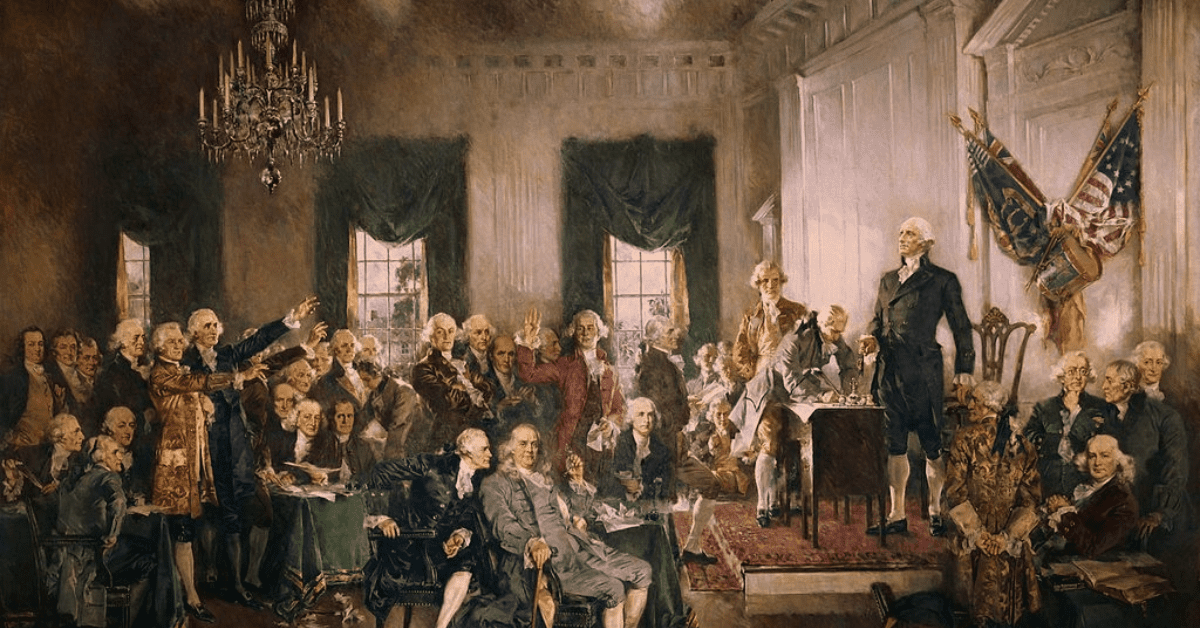
- September 17: Constitution signed
- The Constitution was presented and read aloud; several delegates expressed concerns yet restrained their reservations in order to achieve a sense of unanimity.
Changed the base of representation in the House of Representatives from 1:40,000 to 1:30,000 with the support of Washington.
Randolph's prediction: "Nine states will fail to ratify the plan and confusion must ensue."
Voted (10 - 1) to deposit the Journals (Secretary Jackson's notes) with the President, subject to the orders of Congress.
Heard <Franklin's "Rising Sun" speech.
Signed the Constitution and adjourned, Mason, Randolph and Gerry refused to sign; Read signed Dickinson'sname in his absence.
"The business being thus closed, the Members adjourned to the City Tavern, dined together and took a cordial leave of each other."
Madison's Notes of the Debates
|