What principles of the American Founding does the Republican Party Platform of 1856 cite as the basis of its political positions? How does the platform address the crisis of "Bleeding Kansas?" Why did the platform oppose the Ostend Circular?
How does the Republican platform differ from the Democratic Party platform of 1856? Are there avenues for compromise that might have prevented secession and civil war in five years? What were the fundamental disagreements between the Republicans and Democrats in 1856?
Introduction
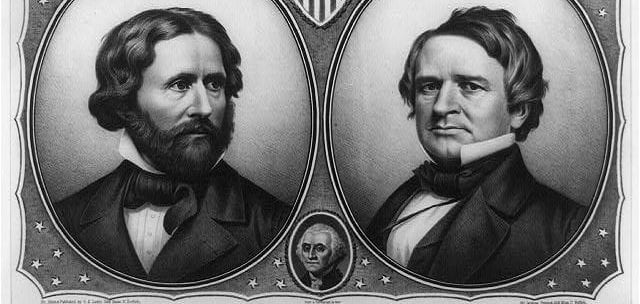
Several American towns claim to be the birthplace of the modern Republican Party, founded in 1854, although no one doubts why the party was established. The party founders, united by their opposition to the Kansas-Nebraska Act of 1854, opposed the expansion of slavery into the western territories of the United States. Significantly, they did not call for the immediate abolition of slavery, though that did not prevent their Democratic opponents from calling Republicans abolitionists. The party leadership consisted of former Whigs, Free-Soilers, and defectors from the American Party, also known as the Know-Nothing Party. Its voters were Protestant professionals, businessmen, and prosperous farmers. The anti-immigrant and anti-Catholic Know-Nothings nominated former President Millard Fillmore in 1856. They played the role of spoilers to the campaigns of Republican John C. Frémont and Democrat James Buchanan. Though Buchanan ultimately won the election, close observers knew the Republicans could win in 1860 because of their strong northern support in 1856.
Philadelphia hosted the Republicans’ first national nominating convention in 1856, where the delegates selected John C Frémont (1813–1890) of California as the presidential candidate. Frémont, best known for his service in the Mexican-American War and his exploration of the West, was one of California’s first two United States senators. Frémont was anti-slavery despite his roots as a native Southerner. The party platform of 1856 opposed the extension of slavery into the western territories. Several of the planks focused on the recent violence in Kansas. Pro-slavery and anti-slavery settlers rushed into Kansas following the passage of the Kansas-Nebraska Act in 1854, which allowed the voters of the territory to choose whether it would enter the Union as a free state or a slave state. The Republican platform accused the government of fomenting the violence and urged Kansas’s admission to the Union as a free state. It also urged funding for the transcontinental railroad and navigable river and harbor improvements to promote the nation’s commercial interests.
—Ray Tyler
“Republican Party Platform of 1856,” Gerhard Peters and John T. Woolley, The American Presidency Project. https://www.presidency.ucsb.edu/node/273293
This Convention of Delegates, assembled in pursuance of a call addressed to the people of the United States, without regard to past political differences or divisions, who are opposed to the repeal of the Missouri Compromise;1 to the policy of the present Administration; to the extension Slavery into Free Territory; in favor of the admission of Kansas as a Free State; of restoring the action of the Federal Government to the principles of Washington and Jefferson; and for the purpose of presenting candidates for the offices of President and Vice-President, do resolve as follows:
Resolved: That the maintenance of the principles promulgated in the Declaration of Independence, and embodied in the Federal Constitution are essential to the preservation of our Republican institutions, and that the Federal Constitution, the rights of the States, and the union of the States, must and shall be preserved.
Resolved: That, with our Republican fathers, we hold it to be a self-evident truth, that all men are endowed with the inalienable right to life, liberty, and the pursuit of happiness, and that the primary object and ulterior design of our Federal Government were to secure these rights to all persons under its exclusive jurisdiction; that, as our Republican fathers, when they had abolished Slavery in all our National Territory,2 ordained that no person shall be deprived of life, liberty, or property, without due process of law, it becomes our duty to maintain this provision of the Constitution against all attempts to violate it for the purpose of establishing Slavery in the Territories of the United States by positive legislation, prohibiting its existence or extension therein. That we deny the authority of Congress, of a Territorial Legislation, of any individual, or association of individuals, to give legal existence to Slavery in any Territory of the United States, while the present Constitution shall be maintained.
Resolved: That the Constitution confers upon Congress sovereign powers over the Territories of the United States for their government; and that in the exercise of this power, it is both the right and the imperative duty of Congress to prohibit in the Territories those twin relics of barbarism — Polygamy, and Slavery.
Resolved: That while the Constitution of the United States was ordained and established by the people, in order to “form a more perfect union, establish justice, insure domestic tranquility, provide for the common defense, promote the general welfare, and secure the blessings of liberty,” and contain ample provision for the protection of the life, liberty, and property of every citizen, the dearest Constitutional rights of the people of Kansas have been fraudulently and violently taken from them.
Their Territory has been invaded by an armed force;
Spurious and pretended legislative, judicial, and executive officers have been set over them, by whose usurped authority, sustained by the military power of the government, tyrannical and unconstitutional laws have been enacted and enforced;
The right of the people to keep and bear arms has been infringed.
Test oaths of an extraordinary and entangling nature have been imposed as a condition of exercising the right of suffrage and holding office.
The right of an accused person to a speedy and public trial by an impartial jury has been denied;
The right of the people to be secure in their persons, houses, papers, and effects, against unreasonable searches and seizures, has been violated;
They have been deprived of life, liberty, and property without due process of law;
That the freedom of speech and of the press has been abridged;
The right to choose their representatives has been made of no effect;
Murders, robberies, and arsons have been instigated and encouraged, and the offenders have been allowed to go unpunished;
That all these things have been done with the knowledge, sanction, and procurement of the present National Administration; and that for this high crime against the Constitution, the Union, and humanity, we arraign that Administration, the President, his advisers, agents, supporters, apologists, and accessories, either before or after the fact, before the country and before the world; and that it is our fixed purpose to bring the actual perpetrators of these atrocious outrages and their accomplices to a sure and condign punishment thereafter.3
Resolved, That Kansas should be immediately admitted as a state of this Union, with her present Free Constitution, as at once the most effectual way of securing to her citizens the enjoyment of the rights and privileges to which they are entitled, and of ending the civil strife now raging in her territory.
Resolved, That the highwayman’s plea, that might makes right,” embodied in the Ostend Circular,4 was in every respect unworthy of American diplomacy, and would bring shame and dishonor upon any Government or people that gave it their sanction.
Resolved, That a railroad to the Pacific Ocean by the most central and practicable route is imperatively demanded by the interests of the whole country, and that the Federal Government ought to render immediate and efficient aid in its construction, and as an auxiliary thereto, to the immediate construction of an emigrant road on the line of the railroad.
Resolved, That appropriations by Congress for the improvement of rivers and harbors, of a national character, required for the accommodation and security of our existing commerce, are authorized by the Constitution, and justified by the obligation of the Government to protect the lives and property of its citizens.
Resolved, That we invite the affiliation and cooperation of the men of all parties, however differing from us in other respects, in support of the principles herein declared; and believing that the spirit of our institutions as well as the Constitution of our country, guarantees liberty of conscience and equality of rights among citizens, we oppose all legislation impairing their security.
Footnotes
- 1. In 1820, Congress admitted Maine in the Union as a free state and Missouri as a slave state, thus keeping the balance of power in the U.S. Senate. Also agreed that slavery might permanently exist south of 36° 30¢ N and prohibited North of 36° 30¢ with the exception of Missouri.
- 2. Republicans contended that the Constitution made freedom the national standard. Slavery was allowed in only those states that enacted legislation protecting slavery.
- 3. Refers to violence in Kansas following the passage of the Kansas-Nebraska Act of 1854, nicknamed “Bleeding Kansas.”
- 4. An 1854 statement drafted by Secretary of State James Buchanan, Spanish Envoy Pierre Soule, and U.S. Ambassador to France John Mason, recommending that the U.S. acquire Cuba.
Prior Document
No prior document in this Era
Next Document
No next document in this Era

Conversation-based seminars for collegial PD, one-day and multi-day seminars, graduate credit seminars (MA degree), online and in-person.